
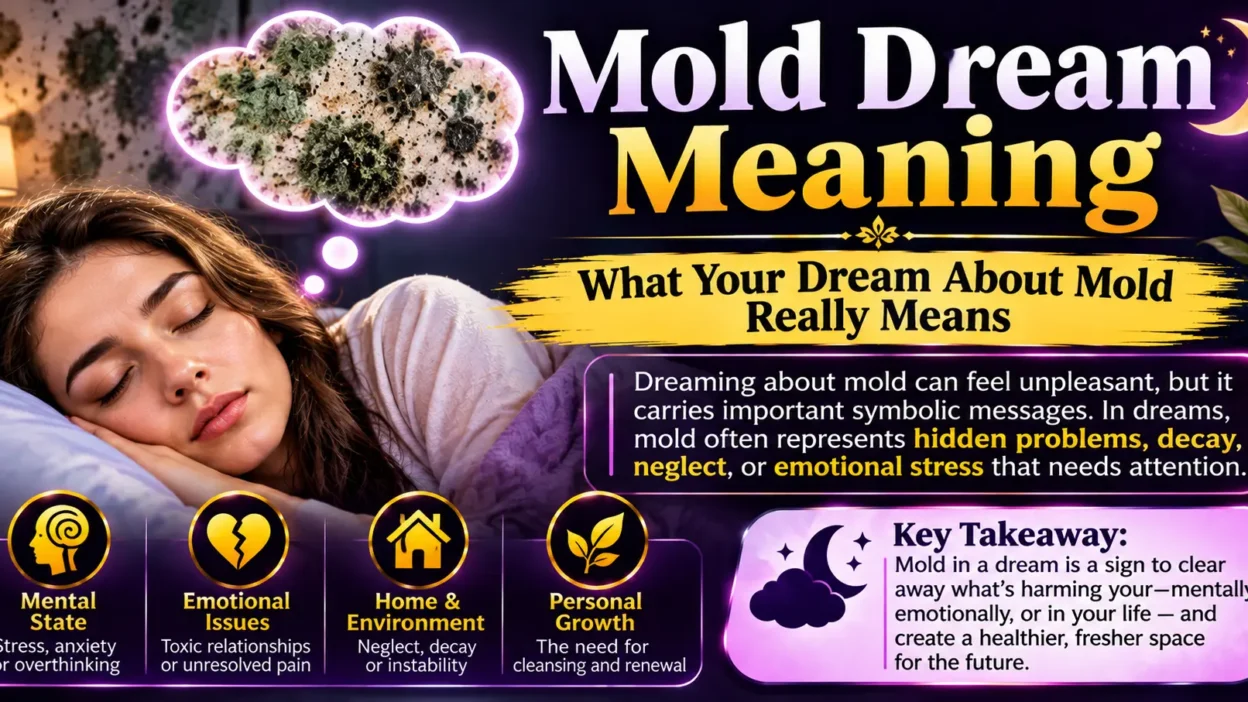
If you woke up unsettled by a dream about mold, you’re not imagining things; this is one of the most common decay-related dreams people search for. Mold dream meaning centers on neglect, hidden problems, and slow decay, but it also carries a more hopeful thread: transformation and renewal.
Unlike dreaming of dirt or rust, mold is alive, it grows, spreads, and reacts to its environment, which is exactly why your subconscious may have chosen it. This guide breaks down what mold dreams mean by scenario, color, psychology, and cultural tradition plus what actually to do next.
Quick Answer: At its core, the mold dream meaning points to something in your life you’ve neglected or avoided an emotion, relationship, habit, or responsibility that’s been left to “fester” quietly. Where the mold appears (food, walls, skin) and how you react to it (disgust, cleaning, ignoring it) shape the specific meaning.
It’s rarely a literal warning, though vivid or recurring mold dreams are worth reflecting on rather than dismissing.
What Does It Mean to Dream About Mold?
Mold dream meaning generally symbolizes neglect, stagnation, or a problem that’s been quietly growing because it wasn’t addressed in time. It can also represent the breakdown of an old habit, belief, or relationship that makes room for something new.
Mold behaves differently than other decay symbols. Rust forms slowly and passively. Dirt just accumulates. Mold, on the other hand, is a living organism; it needs moisture, stillness, and darkness to spread, and it actually grows the longer it’s ignored.
That’s likely why your subconscious reached for it instead of a simpler symbol of neglect: mold implies something is still active, still changing, still asking for a response.
This gives mold dreams two distinct tracks of meaning, and most interpretations fall into one or the other:
- The warning track: unresolved emotions, avoided conversations, or responsibilities that have been left in the dark too long
- The renewal track: an old identity, belief, or relationship that’s naturally breaking down to make room for something healthier
Which track applies usually comes down to how the dream felt. Disgust and panic tend to point toward the warning track. Curiosity or calm acceptance tends to point toward renewal. Keeping this two-track framework in mind is the single most useful key to mold dream meaning as you read through the scenarios below.
Mold Dream Meaning and Scenarios What Each One
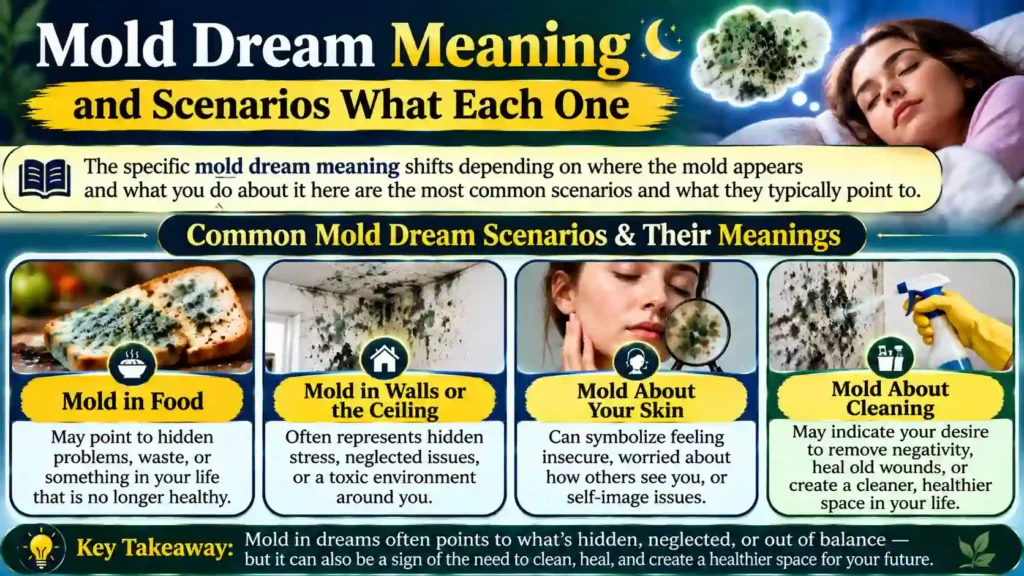
The specific mold dream meaning shifts depending on where the mold appears and what you do about it here are the most common scenarios and what they typically point to.
Mold Dream Meaning About Food
Mold on food in a dream usually reflects a missed opportunity or a form of self-care that’s gone stale. Think of a project you let sit too long, a relationship you stopped nurturing, or a version of self-discipline that curdled into guilt.
This scenario often surfaces during periods of diet stress, financial tightness around groceries, or general burnout around “keeping yourself fed” in a broader sense emotionally as much as literally.
Mold Dream Meaning About Walls or the Ceiling
A mold dream involving walls or the ceiling typically points to boundary or security concerns the structural parts of your life that are supposed to keep you safe. Walls represent privacy and personal limits; ceilings represent what’s hanging over you mentally, like pressure or unresolved worry.
If the mold was specifically overhead, on the ceiling, it often reflects a mental or emotional weight you’ve been carrying without fully naming chronic stress, a lingering disappointment, or a low hum of anxiety that’s been part of the background for too long.
Mold Dream Meaning About Your Skin or Body
Mold appearing on your own skin or body in a dream tends to point to self-neglect or a feeling of being “tainted” by shame, guilt, or exhaustion. Because skin represents how you present yourself to the world, this scenario often shows up when you’re worried about how others perceive you, or when you’re being unusually hard on yourself.
It’s also common after a stretch of poor sleep, physical burnout, or an unresolved conflict you haven’t voiced out loud.
Mold Dream Meaning About Cleaning
Dreaming that you’re actively cleaning mold is one of the more encouraging scenarios; it signals readiness to act and a genuine desire for repair, not just avoidance disguised as good intentions. If the cleaning felt endless or impossible, it may reflect perfectionism rather than a lack of progress.
This scenario shows up frequently around the start of therapy, a decluttering project, or any moment where you’ve decided even quietly that something needs to change.
Scenario vs. Meaning vs. Reflection Question
| Mold on food | Missed opportunity, neglected self-care | What have I let “expire” without noticing? |
| Mold on walls/ceiling | Boundary or security concerns | Where do I feel unprotected or exposed? |
| Mold on skin/body | Shame, self-neglect | What part of myself have I stopped tending to? |
| Cleaning the mold | Readiness to confront a problem | What’s the first small step I can take today? |
| Mold spreading fast | Anxiety about losing control | What feels like it’s escalating faster than I can manage? |
| Someone else has the mold | Concern or projection | Am I carrying a worry that isn’t mine to fix? |
What Does the Color of Mold Mean in a Dream?
The color mold dream meaning adds a layer of intensity to the meaning black mold tends to signal deeper, more urgent issues, while green or white mold usually points to something milder and still manageable.
- Black mold, the most emotionally loaded version, often tied to a serious or long-tolerated source of toxicity: a draining relationship, a job that’s quietly eroding your confidence, or grief you haven’t fully processed.
- Green mold generally reflects a more natural, lower-stakes kind of decay. Something is shifting, but it isn’t a crisis; it’s closer to a seasonal change than a five-alarm fire.
- White mold often points to something just beginning to surface. It’s subtle, early-stage neglect rather than an entrenched problem, which makes it easier to address before it spreads.
Worth noting: this is symbolic color-coding, not a diagnosis. If you’ve been dealing with real black mold in your home, your brain may simply be replaying that memory rather than sending you a deeper message more on that distinction below.
Is Dreaming About Mold a Bad Sign?
Mold dream meaning is not inherently a bad omen, it’s better understood as feedback about conditions in your life that need air, attention, or change, not a prediction of misfortune.
Dreams rarely function like fortune-telling. They tend to reflect what your mind has been chewing on, not what’s destined to happen. A mold dream is closer to an internal status update than a warning label: too much dampness, not enough airflow, metaphorically speaking.
If the dream motivated you to have an honest conversation, tidy up a neglected corner of your life, or simply notice something you’d been avoiding, it’s already done its job regardless of how unpleasant it felt while you were in it.
Does Dreaming About Mold Mean There’s Real Mold in My House?
Real mold exposure can occasionally influence a mold dream if you’ve recently seen or smelled it in your space, but most mold dreams are symbolic rather than a literal signal about your home. If you’ve had recent contact with real mold, your brain may simply be replaying that sensory memory, which makes a quick, practical check of damp areas worthwhile.
The brain is very good at folding recent, mundane experiences into dream imagery. If you’ve scrubbed a shower, read an article about home hazards, or noticed a musty smell recently, that residue can show up in a dream without carrying any deeper meaning at all.
That said, it doesn’t hurt to do a quick real-world check: bathrooms, basements, window sills, and anywhere humidity tends to collect. Ruling out an actual problem is a five-minute task, and it lets you engage with the symbolic meaning without the nagging “but what if it’s literal” question in the back of your mind.
The Psychological Meaning of Mold in Dreams
Psychologically, mold dreams are most often linked to the Jungian “Shadow”, the parts of yourself you’ve pushed out of conscious awareness and to Freud’s idea of repressed material resurfacing in disguised form.
Carl Jung’s framework fits the mold particularly well because of that same “living decay” quality mentioned earlier. The Shadow isn’t a fixed, dead thing sitting in storage; it’s an active, growing part of the psyche that develops in the dark precisely because it’s ignored. A dream about mold spreading in a neglected room maps almost literally onto Jung’s idea of shadow material accumulating the longer it goes unexamined.
Sigmund Freud, working from a different angle, would likely read a mold dream as a “return of the repressed”, an anxiety, memory, or desire the conscious mind tried to suppress, now resurfacing in an unpleasant, disguised form. The specific location of the mold (food, body, home) would offer clues about which repressed material is trying to surface.
A more modern, cognitive-behavioral lens adds a third layer: mold as a metaphor for negative thought patterns that spread quietly and reshape your perception over time, the way a persistent inner critic can “color” everything if it goes unchallenged.
Cultural and Religious Interpretations of Mold Dreams
Cultural and religious traditions read mold dreams through the lens of purity, stewardship, and cycles of decay and renewal — with meaning shifting significantly depending on the tradition.
Biblical and Christian Mold Dream Meaning
In the Old Testament, specifically Leviticus 14, mold or mildew found in a house is treated as a “defiling disease” requiring formal purification rituals, sometimes even dismantling part of the structure. Read symbolically, a mold dream in this tradition often points to a call for spiritual housekeeping: examining your life for a compromise, resentment, or small sin that’s taken root somewhere hidden.

Islamic Dream Interpretation of Mold
Within Islamic tradition, cleanliness (taharah) holds real spiritual weight, so a mold dream is often read as a nudge toward self-reflection and purification of intention. Worth flagging: classical dream dictionaries such as Ibn Sirin’s are generally understood to define “mold” primarily as a casting mold for pastries, shoes, or metalwork rather than fungal mold, so interpretations drawn specifically from that text may not map cleanly onto the decay-based meaning most people are searching for today.
Buddhist and Hindu Perspectives on Mold in Dreams
In Buddhist thought, mold is a vivid stand-in for anicca, or impermanence the idea that all conditioned things change, and resisting that change causes suffering. A mold dream here is less a warning and more an invitation toward acceptance. In some Hindu households, where daily ritual and the upkeep of sacred space carry real significance, a symbol like mold could plausibly be read as a nudge to refresh a routine that’s slipped though this is a general extension of that value system rather than a documented, singular teaching.
Other Cultural Lenses: Energy, Balance, and Household Care
Beyond the traditions above, several cultural frameworks connect a tidy, well-tended home to broader harmony in feng shui influenced thinking, for instance, stagnant conditions like mold are sometimes associated with blocked energy flow, and in many communities with strong traditions of communal household care, unaddressed decay can be read less as an individual failing and more as a shared responsibility. These are broader value patterns rather than fixed, universally agreed interpretations, so hold them loosely alongside the more specifically documented traditions above.
Cultural Lens vs. Core Meaning
| Biblical/Christian | Spiritual impurity requiring cleansing (Leviticus 14) |
| Islamic | Neglect of cleanliness (taharah); moral/spiritual decay |
| Buddhist | Impermanence (anicca); non-attachment |
| Hindu (general extension) | Possible disruption to household ritual rhythm |
| Feng shui–influenced | Blocked energy flow; stagnant household chi |
What Should You Do After a Mold Dream?
The most useful response to a mold dream is a small, concrete action not analysis paralysis: name the one area of neglect the dream pointed to, then take one specific step toward it this week.
- Journal it while it’s fresh. Write down where the mold was, how it made you feel, and what you did in the dream cleaning, ignoring, fleeing.
- Pick one real-world parallel. If the mold was on food, is there a self-care habit you’ve let slide? If it was on the walls, is there a boundary conversation you’ve been putting off?
- Set a tiny, time-boxed action. Fifteen minutes of a specific task, a drawer, an email, a conversation does more than an hour of vague rumination.
- Let recurring dreams be a signal, not a source of anxiety. If the same mold dream keeps showing up, it usually means the underlying issue hasn’t been addressed yet, not that something is wrong with you.
Whichever track your dream falls on warning or renewal the mold itself isn’t the point. It’s a signal pointing toward whatever’s been sitting in the dark a little too long.
Frequently Asked Questions
What does it mean when you dream about mold?
It usually signals neglect or an unresolved issue that’s been left unattended, though the exact meaning depends on where the mold appears and how you react to it in the dream.
What is the spiritual meaning of mold in a dream?
Spiritually, mold often represents impurity or spiritual neglect that calls for cleansing, but it can also symbolize the natural, necessary breakdown of an old identity or belief before renewal.
What does black mold in a dream mean?
Black mold typically points to a more serious or long-tolerated source of toxicity, such as a draining relationship, chronic stress, or grief that hasn’t been fully processed.
Why do I keep dreaming about mold?
Recurring mold dreams usually mean the underlying issue is still active and unaddressed; try rewriting the dream’s ending in your mind opening a window, cleaning it fully to shift the pattern.
What does it mean to dream about moldy food?
Moldy food in a dream often reflects a missed opportunity or a form of self-nourishment, literal or emotional, that’s been neglected past the point of usefulness.
Does dreaming about mold mean I have a health problem?
Dreaming about mold does not directly indicate a health problem, since dream imagery doesn’t diagnose physical illness — though if you have real concerns about your living environment, it’s worth checking your space alongside reflecting on the symbolism.
What’s the difference between dreaming about mold and dreaming about dirt or decay?
Dirt suggests general neglect or mess, while mold implies something actively growing and spreading. If ignored it carries more urgency than a static symbol like dirt or rust.
Is dreaming about mold connected to a relationship?
Dreaming about mold can be connected to a relationship mold on shared spaces, clothing, or food often points to resentment, distance, or unspoken issues that have quietly built up over time.
Conclusion
At its core, mold dream meaning comes down to two intertwined ideas: something has been neglected, and something is ready to change. Whether the mold showed up on food, walls, or your own skin, the dream is less about the substance itself and more about what it’s covering up a boundary, a habit, an emotion left too long in the dark.
The color, location, and your reaction inside the dream all shape the specifics, but the invitation is usually the same one: open a window, look closely at what’s been quietly growing, and decide what deserves your attention next. Whatever shape your mold dream took, the meaning usually comes down to something in your life asking for air and attention and that’s a far gentler message than it first appears.
Further Reading: White Cat Dream Meaning: 5 Shocking Secrets Behind This Mysterious Omen

Samuel Brooks researches biblical references to dreams, visions, symbols, and spiritual messages. He focuses on creating balanced, practical articles that help readers understand dream symbolism while keeping Scripture at the center.